
Drone Spraying in Dense Brassica Canopies: Coverage, Timing and What the Data Shows
The question agronomists ask most consistently about drone spraying is the one that matters most: does it penetrate a dense canopy?
For cereals and oilseed rape, there is reasonable trial data to draw on. For brassica crops – cauliflower, calabrese, broccoli, cabbage – the question is sharper, because the canopy architecture is fundamentally different and the consequences of poor coverage are direct. A fungicide that sits on the upper leaf surface without reaching the mid-canopy in a heading calabrese is not doing the job it needs to do.
This article addresses the canopy penetration question directly, covers what factors govern coverage in dense brassica crops, explains how timing and application parameters interact, and sets out where drone spraying delivers meaningful advantages for a commercial brassica programme.
It is written for agronomists and farm managers already working with commercial brassica acreage, and is not intended for research purposes.
Why Canopy Architecture Matters More in Brassicas Than Most Crops
Cereals and oilseed rape present a relatively open canopy – particularly at early growth stages when most fungicide applications are timed. Brassica crops are different. Cauliflower and calabrese develop tightly reflexed outer leaves that partially close over the developing curd. Cabbage forms a dense, overlapping head structure that actively sheds spray away from the inner leaf surfaces. Broccoli, at heading, has a canopy dense enough to create significant shadowing at mid-canopy level.
The practical implication is that coverage in brassicas requires more than depositing product on the upper surface. For key targets – downy mildew in calabrese, ring spot and alternaria in cabbage, and aphid colonies that establish in protected micro-environments – coverage needs to reach into canopy layers that are partially occluded.

This is the legitimate technical question about drone application in brassicas: not whether drones can spray, but whether the physical characteristics of drone application – spray height, rotor wash, droplet size, and carrier volume – produce coverage profiles that are sufficient for these targets.
What Rotor Wash Does in a Dense Canopy
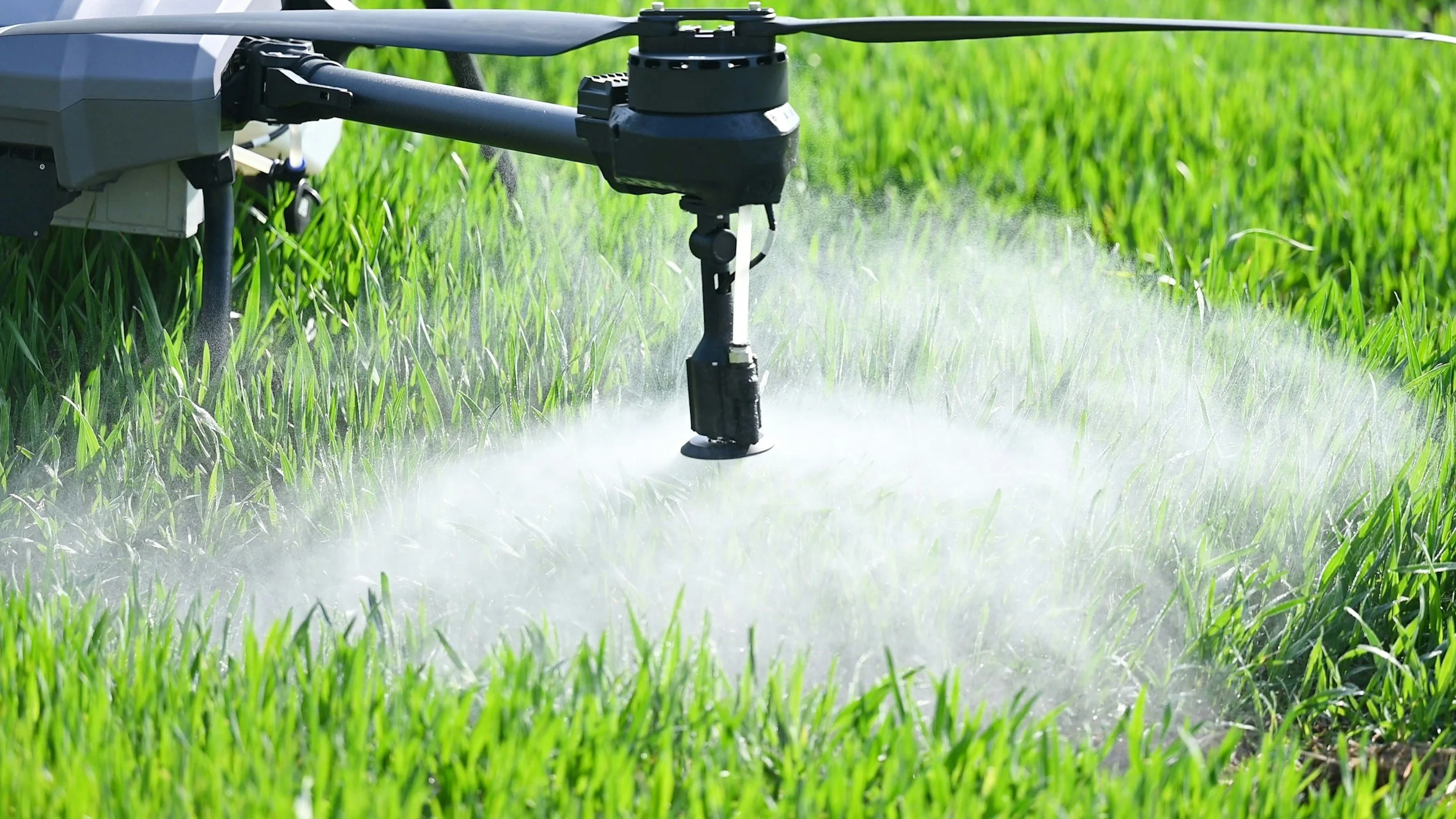
Drone sprayers operate differently from ground-based equipment in one critical respect: the rotor downwash actively moves the canopy during application. On multi-rotor agricultural platforms, the downwash from the propellers creates a sustained downward airflow across the spray swath that displaces upper leaves and opens temporary channels for droplets to penetrate to lower canopy layers.
This effect is most pronounced with larger agricultural drones – platforms with rotor diameters and payload capacities designed for field-scale application rather than survey work. The XAG P100, for example, generates sufficient downwash to visibly move the canopy at standard operating height, which directly improves penetration into the mid-canopy zone compared to calm-air fixed-wing or boom application where the canopy is static.
The practical outcome in brassica crops is that rotor wash compensates partially for the canopy architecture challenge. It is not a complete solution – no single application parameter is – but it is a meaningful one, and it is a characteristic of drone application that conventional ground rigs do not have.
The Three Variables That Govern Coverage in Brassica Spraying
1. Carrier volume
Standard drone spraying rates for agricultural applications typically fall in the range of 15 to 30 litres per hectare, significantly lower than conventional boom application. In brassica crops with a dense canopy, there is a genuine case for operating towards the upper end of this range – or above it for specific high-value applications – to ensure adequate distribution across the full canopy profile.
The appropriate rate depends on crop growth stage, target, and product. For contact-acting insecticides where mid-canopy deposition is critical, a higher carrier volume is justified. For systemic fungicides with good rainfastness where upper canopy coverage initiates uptake, a lower volume may be sufficient. This is exactly the kind of decision that should involve an agronomist reviewing the product label alongside the application method – and it is a conversation worth having before the season begins, not during a spray window.
2. Operating height and swath width
Operating height directly affects the balance between rotor wash penetration and spray drift. Lower passes increase canopy disturbance and improve mid-canopy penetration, but reduce the effective swath width and increase the number of passes required to cover the field. Higher passes improve efficiency but reduce the penetration effect.
For brassica applications where canopy penetration is the objective, a lower operating height – typically in the range of one to two metres above the canopy – is generally preferable, accepting the reduced swath width as a trade-off for better distribution. On large commercial acreages, this needs to be factored into the job planning and time estimates.
3. Droplet size and nozzle configuration
Smaller droplets improve canopy penetration by remaining airborne longer in the rotor wash and distributing into partially occluded spaces. However, smaller droplets also increase drift risk, particularly in the open conditions common to South West coastal and elevated farmland where wind speeds at canopy level can be significant even when conditions appear suitable.
The appropriate droplet size is a compromise between penetration and drift management, and it varies by product type, target, and field conditions. For brassica applications, medium to fine droplets are generally appropriate for fungicide and insecticide applications targeting mid-canopy pests and diseases. For applications where upper canopy coverage is sufficient – broad-spectrum foliar nutrition, for example – coarser droplets are preferable and reduce drift risk.
A professional contractor should be adjusting nozzle configuration to the specific application, not running a single default setting across all jobs.
Timing: Where Drone Mobilisation Changes the Programme
The coverage question is technical and important. The timing question is, for many commercial brassica programmes, equally significant – and it is where drone services offer an advantage that has nothing to do with nozzle configuration.
Brassica crops have compressed spray windows. The interval between when an application needs to happen and when it is too late – particularly for downy mildew at heading, or for cabbage aphid virus management in the pre-crop establishment phase – is often narrow. On a farm managing multiple brassica fields across a season, the ability to mobilise a spray application within 24 to 48 hours of a decision being made is operationally significant.
Ground-based contractors working across a regional customer base face the same weather-window constraints as everyone else, and their availability does not always align with the agronomic window. A drone contractor based in Cornwall and covering a compact operating area has a different mobilisation profile from a national operator dispatching from outside the region.
For a commercial brassica programme where timing precision matters, the practical question is not only whether drone spraying produces adequate coverage – it is whether the combination of coverage adequacy and mobilisation speed makes it more likely that the application happens at the right time.
What This Means for a Commercial Brassica Programme in Cornwall
Cornwall and west Devon are significant commercial brassica-producing areas. Cauliflower, calabrese, broccoli, and cabbage are extensively grown, and the combination of Atlantic weather patterns, variable terrain, and compressed growing seasons creates exactly the conditions where drone application is likely to contribute to a well-managed programme.
Drone application in brassicas is not a direct replacement for every ground-based spray operation. There are growth stages and product types where conventional equipment remains the most appropriate choice, and an agronomist advising a large brassica holding should be using drone application selectively rather than as a default.
The scenarios where it tends to add clear value are:
Heading applications for diseases and pests where timing precision is critical and ground conditions or crop height make machinery access difficult or damaging. Targeted applications to specific problem areas identified through multispectral survey — applying to a mapped zone of disease pressure rather than the full field. Operations on slopes, headlands, or fields with restricted access points where ground equipment is impractical. Situations where a spray window opens after a period of wet weather and ground conditions will not support machinery for several days.
Editor note: If Drone Logistics has conducted any brassica applications to date – even a single field – include a brief factual note here: crop type, growth stage, product type, and outcome if known. Even a single sentence of real data significantly strengthens this section.
Talking to Drone Logistics About Your Brassica Programme
Drone Logistics operates commercially across Cornwall and Devon, including on brassica holdings. If you are an agronomist or farm manager working with cauliflower, calabrese, broccoli, or cabbage production and want to understand how drone application fits into your spray programme – what it can do, what it cannot, and what the practical constraints are – we are straightforward about all of it.
russell.pierpoint@drone-logistics.co.uk